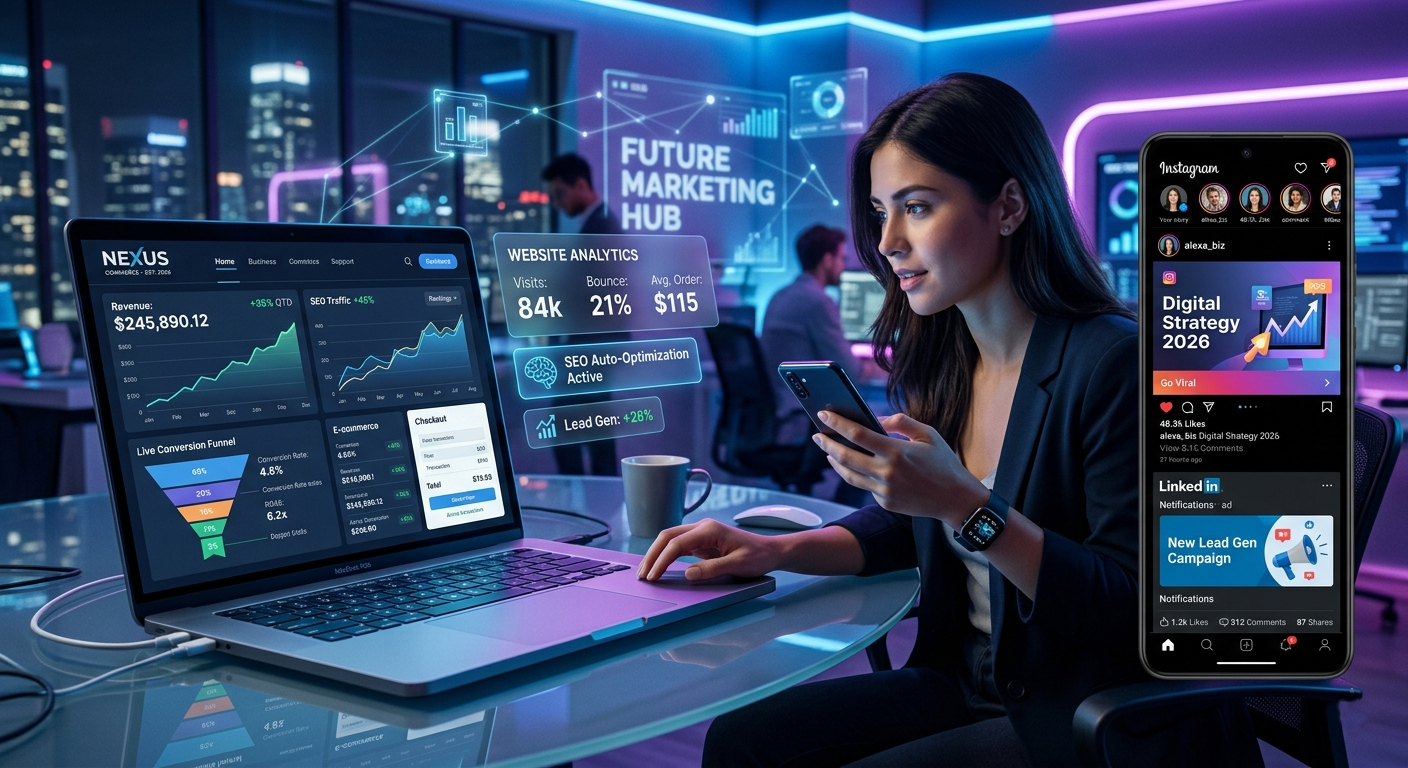
Website vs Social Media: What Drives More Revenue in 2026?
|
QUICK ANSWER
In 2026, websites drive more long-term, compounding revenue than social media — converting visitors at 3–5% versus social’s 0.5–1.5%. But social media remains the engine of awareness and community. The highest-performing businesses use a hybrid strategy: social platforms attract audiences, the website converts and owns them. For businesses in Sri Lanka and globally, this is now shaped by a third force: AI-powered search through SEO, GEO, and AEO.
|
There is a war happening quietly inside every marketing budget in 2026. On one side: the company website — patient, owned, compounding. On the other: social media — electric, rented, unpredictable. Every rupee, dollar, and pound is being fought over. And for the first time in a decade, the rules have genuinely changed.
Artificial intelligence now mediates a significant portion of how people discover businesses. Google surfaces AI Overviews before ten blue links. ChatGPT recommends service providers. Voice assistants answer purchase-intent questions without ever loading a browser tab. The digital revenue picture in 2026 is not simply “website vs. social” — it is a triangle: owned assets, social signals, and AI visibility. Understanding all three is no longer optional.
|
3–5%
Avg website conversion rate (2026)
|
0.5–1.5%
Avg social media conversion rate
|
42%
Purchase journeys involving AI search
|
3.1×
Higher CLV from website-acquired customers
|
01 THE CASE FOR YOUR WEBSITE
The Case For Your Website
Let’s be unambiguous: in 2026, a well-built, well-optimised website is still the single most powerful revenue asset a business can own. The reasons are structural, not sentimental.
You Own the Audience
Social media platforms are landlords. They set the rules, change the algorithm, and — as any business that built itself entirely on Facebook circa 2012 can attest — can dramatically reduce your organic reach overnight. A website, paired with an email list, is property you own outright. No platform can take it from you. No algorithm update can erase your traffic overnight.
SEO Still Compounds
A blog post optimised for search intent in 2024 continues generating leads in 2026 — often without additional spend. Social content, by contrast, has an average half-life of under 18 hours. The mathematics of compounding content make websites the superior long-term revenue engine by a significant margin. Businesses that invested in SEO three years ago are harvesting that return today.
Conversion Happens on Your Terms
A website lets you design the exact journey from awareness to purchase. Landing pages, calls to action, trust signals, testimonials, pricing tables — every element can be A/B tested and refined. Social media hands the conversion environment to the platform. Your product competes with the next video in the feed.
“Your website is the only digital asset where you control the entire customer experience — from the first impression to the final transaction.”
02 THE CASE FOR SOCIAL MEDIA
The Case For Social Media
Social media’s defence in the revenue conversation is not about conversion rates. It has never been. Its power is upstream — in discovery, trust, and community — and in 2026, that upstream influence is stronger than ever.
Organic Discovery at Scale
TikTok’s search engine is now a primary product discovery tool for consumers under 35. Instagram Reels surface to audiences who have never heard of your brand. YouTube Shorts introduce your expertise before someone has thought to Google you. Social media is the world’s largest and most sophisticated top-of-funnel machine, and it works at a cost-per-impression that traditional advertising cannot match.
Trust & Social Proof
Before a customer visits your website, they frequently look you up on Instagram or LinkedIn to assess credibility. An active, professional, and engaging social presence in 2026 functions as a trust certificate — particularly for B2B services, hospitality, retail, and professional services. A dormant social profile raises red flags that no beautiful website can fully overcome.
Paid Social ROI
For time-sensitive promotions, product launches, and event-driven revenue, paid social — Meta Ads, TikTok Ads, LinkedIn Ads — can deliver measurable revenue within 48 hours of campaign launch. For businesses that need short-cycle, responsive revenue, this velocity is invaluable.
03 HEAD-TO-HEAD: THE NUMBERS
|
FACTOR
|
WEBSITE
|
SOCIAL MEDIA
|
|
Audience Ownership
|
✓ Full ownership
|
✗ Platform-controlled
|
|
Avg. Conversion Rate
|
3–5%
|
0.5–1.5%
|
|
Content Longevity
|
Years (compounding)
|
12–48 hours
|
|
AI Search Visibility
|
High (GEO/AEO)
|
Low
|
|
Top-of-Funnel Discovery
|
Moderate
|
Very High
|
|
Trust Signalling
|
High (credibility)
|
High (social proof)
|
|
Speed to Revenue
|
Weeks–months (SEO)
|
Hours–days (paid)
|
|
Customer Lifetime Value
|
3.1× higher
|
Lower
|
|
Data & Analytics Control
|
Full (GA4, CRM)
|
Platform-limited
|
|
Cost Trajectory
|
Decreasing per lead
|
CPM up ~22%
|
04 THE THIRD FORCE: AI SEARCH
The Third Force: AI Search
The debate between website and social media has been complicated by a third contender — AI-powered search engines and generative answer tools. In 2026, optimising for these is not a future strategy. It is an urgent present priority.
What Is GEO (Generative Engine Optimisation)?
GEO is the discipline of structuring your website’s content, authority signals, and topical depth so that large language models — ChatGPT, Google Gemini, Claude, and others — recommend and cite your brand when users ask relevant questions. Where traditional SEO wins you a position on page one, GEO earns you a mention in the AI-generated answer that many users now read instead of clicking links at all.
|
|
GEO IN PRACTICE
A travel agency that publishes a comprehensive, factually dense guide to Sri Lanka’s best hotels for families is more likely to be cited by an AI assistant answering “best family hotels in Sri Lanka” than a competitor whose website holds the keyword but lacks depth. Authority + comprehensiveness + structured data = GEO visibility.
|
What Is AEO (Answer Engine Optimisation)?
AEO is the practice of formatting content to directly and concisely answer specific questions — in plain language, with appropriate schema markup — so that search engines and AI tools surface your content in featured snippets, voice results, and conversational AI responses.
Crucially, both GEO and AEO are website-centric strategies. Social media posts, however viral, are not indexed for AI-generated answers with anywhere near the authority of well-structured web pages. This is the decisive structural advantage of owning and investing in a website in 2026.
05 THE WINNING STRATEGY: THE REVENUE FLYWHEEL
The Winning Strategy: The Revenue Flywheel
The most commercially successful brands in 2026 are not choosing between website and social media. They are running a revenue flywheel where each channel feeds the next.
Social media creates awareness and community → Short-form content drives traffic to long-form website content → Website content ranks in search and AI engines → Search and AI visibility drives high-intent organic leads → Those leads convert at high rates on the website → Data from website behaviour informs better social content → Cycle repeats, each revolution more efficient than the last.
|
|
RECOMMENDED BUDGET SPLIT 2026 (SMB)
50% — Website development, SEO, GEO, AEO content strategy & technical maintenance · 30% — Social media content creation & paid advertising · 20% — Email marketing, CRM, and conversion rate optimisation
|
For larger enterprises, the proportions shift towards more sophisticated SEO/GEO investment and performance-driven paid social. For micro-businesses and sole traders, the social media proportion may temporarily be higher while website authority is being built — but the goal remains the same: transition audience ownership from rented platforms to owned digital assets.
06 THE SRI LANKA CONTEXT
The Sri Lanka Context
For businesses operating in Sri Lanka — whether serving the local market, attracting international tourists, or exporting services globally — the website-vs-social dynamic has a distinctive local character that demands attention.
WhatsApp and Facebook remain dominant first-touchpoint discovery channels across much of Sri Lanka’s consumer economy. Instagram has accelerated as a discovery channel for hospitality, retail, and food. These social realities make social media marketing non-negotiable for local reach and community-building.
At the same time, Sri Lankan businesses competing for international customers — in tourism, IT outsourcing, professional services, and e-commerce — face audiences whose discovery journey begins predominantly with Google search and, increasingly, AI-generated answers. A Sri Lankan boutique hotel recommended by an AI assistant to a UK traveller planning a trip to Galle has an extraordinary conversion advantage. That recommendation only comes to businesses with authoritative, GEO-optimised websites.
“The businesses in Sri Lanka that will dominate their markets in five years are the ones building website authority today — not just social media followers.”
|
VERDICT
→ The Verdict
Website Wins the Long Game. Social Wins the Short Game. The Flywheel Wins Everything.
If you can only invest in one, invest in your website. It is the only digital asset that compounds, that you fully own, and that AI-powered search engines can index, cite, and recommend. But the businesses that will dominate revenue in 2026 and beyond are building the flywheel — using social media to feed their website, and their website to feed the future. That is the strategy. Everything else is tactics.
|
07 FREQUENTLY ASKED QUESTIONS
Frequently Asked Questions
Questions businesses are actually asking AI assistants and search engines in 2026.
Does a website or social media drive more revenue in 2026?
Websites consistently drive more long-term, compounding revenue than social media in 2026. Websites convert visitors at 3–5% versus social media’s 0.5–1.5%, and businesses that own their website audience enjoy customer lifetime values approximately 3.1 times higher than those acquired through social channels. Social media remains essential for top-of-funnel awareness and community-building, which feeds website revenue. The highest-performing businesses use both in a coordinated flywheel strategy.
What is GEO and why does it matter for revenue in 2026?
GEO stands for Generative Engine Optimisation — the practice of optimising your website’s content, authority, and structured data so that AI tools like ChatGPT, Google Gemini, and Claude recommend and cite your brand in AI-generated responses. In 2026, approximately 42% of purchase journeys involve an AI search query, making GEO as important as traditional SEO. Businesses with GEO-optimised websites appear in AI answers; those without are invisible to an enormous and growing audience segment.
What is AEO (Answer Engine Optimisation)?
AEO is the practice of formatting website content to directly and concisely answer specific questions users ask of search engines and AI assistants. This includes FAQ schema markup, concise direct answers at the top of content, and clear factual statements structured for machine parsing. AEO content surfaces in Google featured snippets, voice search results, and AI-generated answers — giving businesses zero-click visibility and authority positioning.
Why is a website better than social media for long-term business growth?
A website is owned digital property — no platform can change the algorithm and cut your reach overnight. Website content compounds over time through SEO; a well-written article from two years ago continues generating leads today. Websites integrate e-commerce, build email lists, allow full conversion optimisation, and are indexed by search engines and AI tools. Social media reach is rented, and platform advertising costs have risen approximately 22% in the past 18 months.
How should a small business in Sri Lanka split its digital budget in 2026?
For most small businesses in Sri Lanka in 2026, the recommended split is: 50% on website development, SEO, GEO, and AEO content strategy; 30% on social media content creation and paid advertising (particularly on Facebook, Instagram, and WhatsApp for local audiences); and 20% on email marketing, CRM tools, and conversion rate optimisation.
|
Build the Revenue Flywheel for Your Business
Incarnate is Sri Lanka's leading web design and digital marketing agency. We build websites optimised for SEO, GEO, and AEO — and we create social strategies that feed them.
www.incarnate.lk/contact
|