Web Design Trends 2026: What's Shaping the Future
The digital landscape is evolving faster than ever. Here's what's defining web design as we move deeper into 2026.
By Incarnate Magazine | January 2026
---
The web has always been a reflection of our technological capabilities and cultural zeitgeist. As we navigate through 2026, we're witnessing a fascinating convergence of artificial intelligence, immersive experiences, and a renewed focus on human-centered design. The websites that captivate us today aren't just visually stunning—they're intelligent, adaptive, and deeply personal.
The Rise of Generative Interfaces
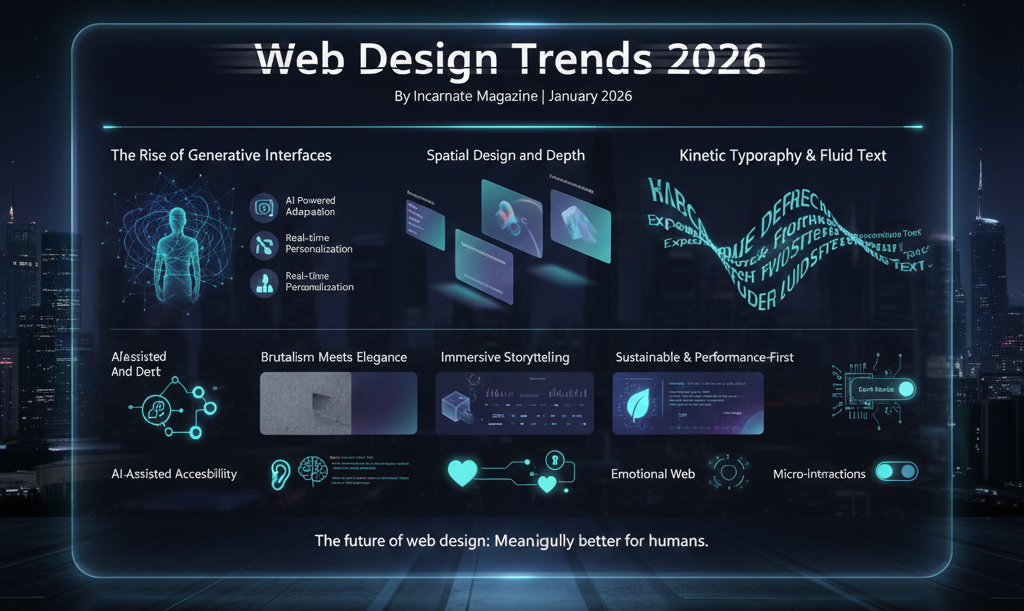
Perhaps the most transformative shift we're seeing is the integration of AI-powered generative interfaces. Websites are no longer static experiences but dynamic canvases that adapt in real-time to user behavior, preferences, and even emotional states. Color schemes shift based on time of day and user mood, layouts reorganize themselves to highlight content most relevant to individual visitors, and typography adjusts for optimal readability based on device, context, and accessibility needs.
This isn't science fiction—it's happening now. Forward-thinking brands are deploying websites that feel less like predetermined templates and more like living, breathing entities that evolve with their audiences.
Spatial Design and Depth
Flat design has had its moment, and designers are now embracing dimensionality in sophisticated new ways. The trend isn't about heavy skeuomorphism or gratuitous shadows—it's about creating subtle depth that guides the eye and enhances usability. We're seeing the rise of what some are calling "neo-dimensionalism": layered interfaces with parallax scrolling, floating elements with soft shadows, and micro-interactions that respond to cursor position in three-dimensional space.
This approach creates hierarchy without clutter, drawing users naturally through content flows while maintaining the clean aesthetics we've come to expect from modern web design.
Kinetic Typography and Fluid Text
Text is no longer just something to read—it's something to experience. Variable fonts have matured to the point where designers can create truly fluid typographic experiences. Letters that stretch, compress, and morph as users scroll. Headlines that react to mouse movement. Pull quotes that animate into view with personality and flair.
The key innovation here is restraint. The best implementations feel purposeful rather than gimmicky, enhancing readability and engagement rather than sacrificing them for spectacle.
Brutalism Meets Elegance
There's a growing tension—and creative synthesis—between brutalist rawness and refined minimalism. Designers are borrowing the honesty and unconventional layouts of brutalism while softening its edges with sophisticated color palettes, smooth animations, and thoughtful spacing. The result is a design philosophy that feels authentic and human without being harsh or inaccessible.
This hybrid approach resonates particularly well with younger audiences who value transparency and authenticity but still expect polished, professional experiences.
Immersive Storytelling Through Scroll
Scroll-triggered narratives have evolved beyond simple parallax effects. In 2026, entire stories unfold as users journey down a page—3D objects rotate into view, data visualizations build themselves in real-time, and video content seamlessly integrates with text in ways that feel cinematic rather than webby.
The technology enabling this—primarily WebGL and sophisticated JavaScript frameworks—has become accessible enough that even smaller studios can create these experiences. The democratization of immersive web design means we're seeing more creative experimentation across the board.
Sustainable and Performance-First Design
There's a growing consciousness around the environmental impact of digital products. Progressive web designers are optimizing for performance not just for user experience but for energy efficiency. This means streamlined code, optimized assets, dark mode as default on OLED screens, and server-side rendering that reduces client-side processing.
The fascinating outcome is that sustainability and performance goals are actually driving better design decisions—faster load times, cleaner interfaces, and more intentional feature sets.
Micro-Interactions with Personality
The details matter more than ever. Every button press, form submission, and navigation transition is an opportunity to inject personality and delight. But the trend in 2026 is toward subtlety—animations that feel native to the platform, haptic feedback on mobile devices that enhances touch interactions, and loading states that entertain without annoying.
The best micro-interactions are almost invisible, noticed only subconsciously but contributing enormously to the overall feel of a product.
AI-Assisted Accessibility
Accessibility is no longer an afterthought, and AI is helping designers ensure inclusive experiences from the start. Tools now automatically suggest color contrast improvements, generate alt text for images, and test interfaces with simulated vision and motor impairments. Some experimental sites are even offering AI-powered personalization for users with specific accessibility needs—simplified layouts for cognitive disabilities, enhanced contrast for low vision, and voice-first navigation options.
This represents a fundamental shift: accessibility as a core feature rather than a compliance checkbox.
The Emotional Web
Perhaps the most intriguing trend is what we might call emotional computing in web design. Sites are beginning to recognize and respond to user frustration, confusion, or delight. If someone is struggling to find information, the interface might proactively offer help. If a user is engaged and exploring, additional related content surfaces naturally.
This requires sophisticated analytics and ethical implementation, but when done well, it creates experiences that feel remarkably human and considerate.
Looking Forward
The websites that will succeed in 2026 and beyond aren't necessarily the flashiest or the most technologically complex. They're the ones that use these emerging tools and techniques in service of genuine human needs—sites that are fast, accessible, beautiful, and surprisingly intuitive.
As designers, our challenge is to embrace these possibilities while maintaining the discipline to ask: does this serve our users, or does it just serve our egos? The answer to that question will separate the trendy from the timeless.
---
The future of web design isn't just about what's technically possible—it's about what's meaningfully better for the humans on the other side of the screen.