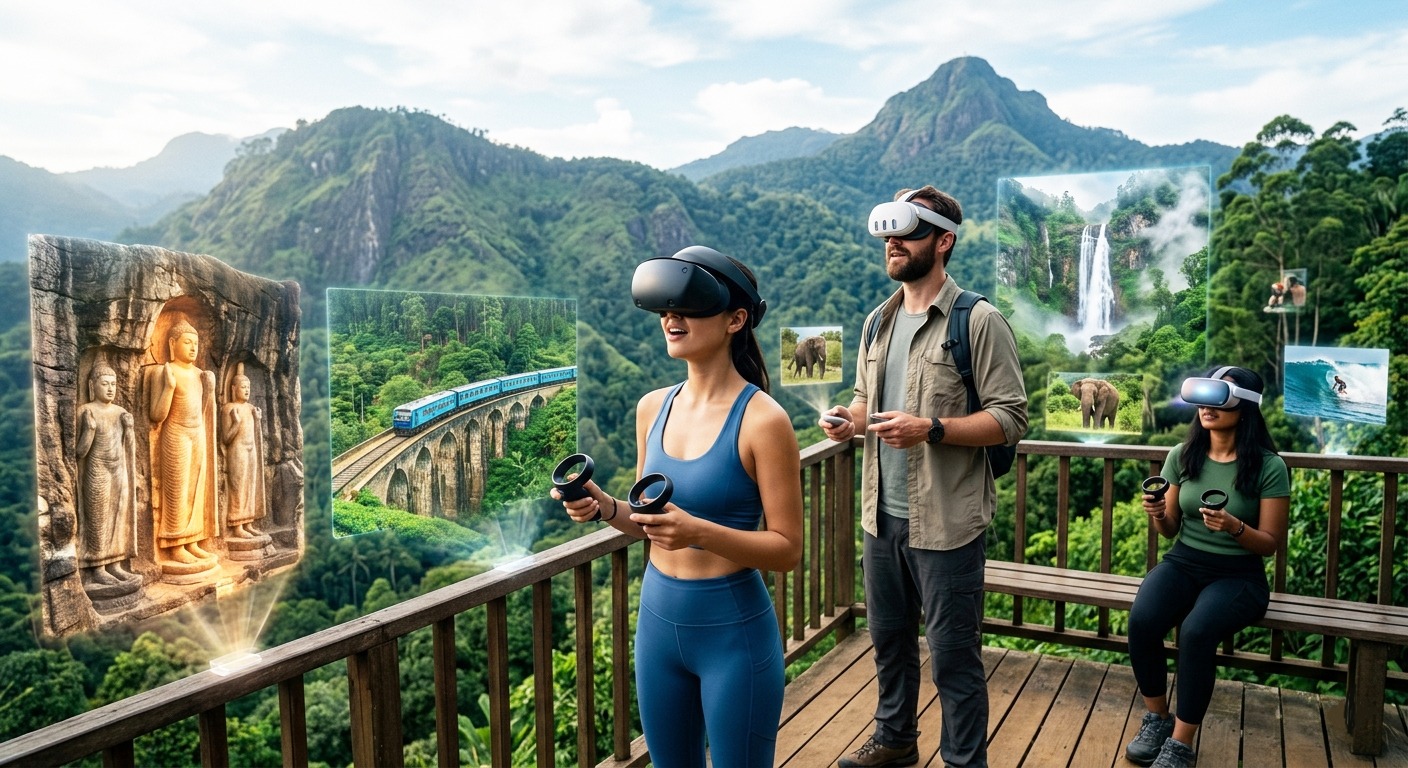
Why Sri Lanka Tourism Needs Virtual Reality Experiences for Tourism Development
Why Sri Lanka Tourism Needs Virtual Reality Experiences for Tourism Development
By Sri Lanka TourismInsights | Published: June2025 | Updated: June 2025
Sri Lanka tourism needs Virtual Reality (VR) experiences because VR allows globaltravellersto preview iconic destinations like Sigiriya, Yala, and Galle Fort before booking increasing tourist confidence, extending reach into new markets, and accelerating post-pandemic recovery. VR reduces the "travel uncertainty gap" and positions Sri Lanka as a tech-forward destination in a competitive South Asian market.
Sri Lanka the Pearl of the Indian Ocean holds some of the world's most extraordinary travel experiences. Ancient rock fortresses, pristine whale-watching coastlines, misty tea-draped highlands, and eight UNESCO World Heritage Sites sit within an island smaller than the state of Alabama. Yet despite its staggering natural and cultural wealth, Sri Lanka consistently punches below its weight in global tourist arrivals compared to rivals like Thailand, Indonesia, and Vietnam.
The gap between potential and performance is, in part, a marketing and discovery problem. Too many prospective visitors simply don't know what Sri Lanka feels like until they land. That is exactly the problem Virtual Reality (VR) tourism is built to solve.
In this article, we explore why integrating VR experiences into Sri Lanka's tourism development strategy is not just a futuristic luxury it is a strategic necessity.
1. The Global VR Tourism Revolution Is Already Here
Virtual Reality tourism is no longer speculative technology. According to the World Tourism Organization (UNWTO), over 40 countries have already invested in immersive destination marketing using VR and 360° video content. Tourism boards from New Zealand to Iceland use VR headset experiences at travel expos, airports, and online platforms to put prospective tourists inside their destinations before they spend a single dollar on flights.
Global VR travel market research projects the sector to exceed $24 billion USD by 2027, growing at a CAGR of over 30%. Destinations that adopt VR now will build acompounding first-mover advantage in digital tourism marketing those that wait risk becoming invisible in an increasingly immersive discovery ecosystem.
Key VR Tourism Milestones Globally:
•Australia deployed VR experiences at 15 major international airports to promote outback tourism.
•Japan's tourism agency used VR to attractvisitorspost-COVID, achieving a 38% increase in pre-booking interest.
•Maldives launched a VRsnorkellingcampaign that drove a 22% uplift in direct resort enquiries.
•India's Incredible India campaign included VR temple walks targeting the European and North American diaspora.
2. Sri Lanka's Tourism Challenges VR Can Directly Address
Sri Lanka's tourism sector has faced a series of sharp shocks in recent years the 2019 Easter Sunday attacks, the COVID-19 pandemic, and the 2022 economic crisis. While arrivals have been recovering, the country needs bold, innovative strategies to rebuildtravellerconfidence and reach entirely new source markets in Europe, North America, and East Asia.
2a. The Travel Uncertainty Gap
Research consistently shows thattravellerswho are unfamiliar with a destination experience higher booking hesitation. Sri Lanka ranks lower in familiarity among Westerntravellerscompared to Thailand or Bali despite offering comparable or superior experiences. VR experiences act as a "try before you fly" mechanism, emotionally connectingtravellersto the destination before committing to a booking.
2b. Showcasing Hidden Gems Beyond Colombo and Galle
Much of Sri Lanka's tourism revenue clusters around Colombo, Kandy, and the southern coastal belt. Regions like Knuckles Mountain Range, Mannar's flamingo lagoons, Trincomalee's diving sites, and the Jaffna peninsula remain dramatically underexplored. VR can give these destinations a global spotlight without the marketing budgets of established resorts levelling the playing field for rural and community-based tourism operators.
2c. Seasonal and Accessibility Barriers
Sri Lanka's dual monsoon seasons create complex travel planning challenges. VR can allow tourists to "experience" destinations year-round in peak conditions, enabling better-informed travel planning and reducing seasonal tourism bottlenecks. VR also opens Sri Lanka's heritage totravellerswith physical disabilities or mobility limitations who cannot access steep ancient sites like Sigiriya Rock Fortress in person.
3. Specific VR Applications for Sri Lanka Tourism Development
Virtual Reality is not a single tool it is an ecosystem of immersive technologies. Here are the most impactful applications for Sri Lanka's tourism landscape:
|
VR Experience Type
|
Sri Lanka Application
|
Tourism Benefit
|
|
360° Destination Tours
|
Virtual Sigiriya climb,Galle Fort walk, Tea estate immersion
|
Pre-booking engagement & emotional connection
|
|
VR Heritage Reconstruction
|
Anuradhapura and Polonnaruwa ancient city recreations
|
Cultural tourism; reaches history enthusiasts globally
|
|
VR Wildlife Safaris
|
Yala leopard safari,Minneriyaelephant gathering
|
Attracts eco-tourists; sustainable, non-intrusive
|
|
VR Whale Watching
|
Blue whale encounters off Mirissa & Trincomalee
|
Appeals to adventure & marine tourism segments
|
|
VR Culinary Experiences
|
Virtual cooking classes: hoppers,kottu, polsambol
|
Food tourism; viral social media marketing potential
|
|
Wellness & Ayurveda VR
|
Virtual Ayurvedic retreat previews in hill country
|
Targets luxury wellness tourism from EU & US markets
|
4. Economic Impact: VR as a Multiplier for Tourism Revenue
The economic case for VR investment in Sri Lanka's tourism sector is compelling. Studies from destinations that have deployed VR marketing campaigns consistently show:
•Increased booking conversion rates of 20–35% when VR experiences are integrated into the customer journey.
•Higher average tripspend travellerswho pre-experienced a destination via VR spent an average of 14% more on accommodation and activities.
•Extended length of stay VR exposure to diverse regions encouraged multi-destination itineraries within a single country.
•Reduced post-arrival disappointment and negative reviews travellersarrived with accurate expectations, improving satisfaction scores.
For Sri Lanka, where tourism directly contributes approximately 12% of GDP and supports over 300,000 jobs, even a modest 15% uplift in tourist arrivals through VR-enhanced marketing could translate into hundreds of millions of dollars in additional revenue and significant employment generation.
5. VR and Sustainable Tourism: A Natural Partnership
Sri Lanka is home to remarkable biodiversity home to over 3,000 flowering plant species, 227 bird species, and globally endangered wildlife including the Sri Lankan elephant, leopard, and blue whale. Over-tourism at fragile sites is a genuine environmental risk.
VR offers a sustainable solution: delivering the emotional impact of visiting ecologically sensitive areas without the physical footprint. A VR experience of nesting sea turtles atRekawabeach or stalking leopards through Yala's scrubland can satisfy the curiosity oftravellerswho might otherwise crowd fragile habitats whilechannellingphysical tourism toward more resilient destinations.
Sri Lanka's National Tourism Strategic Planemphasisesresponsible and sustainable tourism. VR is not just compatible with that mission it actively advances it.
6. Frequently Asked Questions (AEO - FAQ Schema Block)
Q: What is Virtual Reality tourism?
A: Virtual Reality (VR) tourism uses immersive headset technology or 360° video to allow people to experience a destination as if they were physically present, enabling virtual tours of landmarks, wildlife encounters, and cultural experiences from anywhere in the world.
Q: How can VR help Sri Lanka attract more tourists?
A: VR experiences allow potential tourists from markets like Germany, the US, China, and Japan to virtually explore Sigiriya, Yala National Park, Galle Fort, and Kandy's Temple of the Tooth before booking increasing familiarity, reducing booking hesitation, and driving higher conversion rates.
Q: Which Sri Lankan destinations are best suited for VR tourism experiences?
A: Top candidates include Sigiriya Rock Fortress (aerial VR climb), Yala National Park (wildlife safari), Mirissa (blue whale watching), Anuradhapura (ancient city reconstruction), Ella (train ride through tea country), and the Knuckles Mountain Range (hiking immersion).
Q: Does VR tourism replace real travel to Sri Lanka?
A: No. VR tourism acts as a powerful discovery and booking tool, not a substitute. Research consistently shows that VR experiences increase not decrease the likelihood of real-world travel, astravellersbecome emotionally invested indestinationsthey have virtually experienced.
Q: What government support is needed for VR tourism development in Sri Lanka?
A: Effective VR tourism development requires Sri Lanka Tourism (SLTDA) to establish a national VR content production fund, partner with technology companies, integrate VR kiosks at international travel expos and airports in source markets, and mandate digital accessibility standards for heritage site VR reconstructions.
7. A Roadmap: How Sri Lanka Can Implement VR Tourism
Phase 1 - Foundation (2025–2026)
•Commission VR content for the Cultural Triangle (Sigiriya, Polonnaruwa, Anuradhapura)
•Launch 360° video series across YouTube, Meta (Oculus), and Apple Vision Pro platforms
•Deploy VR kiosks at Sri Lanka Tourism counters in London, Frankfurt, Shanghai, and Sydney
Phase 2 - Expansion (2026–2027)
•Extend VR coverage to wildlife, coastal, and wellness destinations
•Integrate VR preview features into Sri Lanka's national tourism booking portal
•Partner with airlines (SriLankanAirlines, Emirates, Qatar) to embed VR content in inflight entertainment
Phase 3 - Innovation (2028+)
•Develop AI-personalisedVR itinerary tools that matchtravellerinterests to Sri Lankan experiences
•Introducemixed-reality (MR) overlays at physical heritage sites for on-site interpretation
•Create a "Virtual Sri Lanka" metaverse tourism hub accessible to global audiences 24/7
Conclusion: The Future of Sri Lanka Tourism Is Immersive
Sri Lanka possesses every ingredient for world-class tourism: ancientcivilisation, extraordinary biodiversity, diverse landscapes, genuine cultural warmth, and a strategic location at the crossroads of global air routes. What has historically been missing is the global awareness to match that potential.
Virtual Reality technology gives Sri Lanka an unprecedented opportunity to let the world experience the island before they ever set foot on it and in doing so, dramatically compress the journey from curiosity to booking. As global tourism competition intensifies andtravellersincreasingly expect immersive digital discovery, the question for Sri Lanka is not whether to invest in VR tourism, but how quickly it can do so.
Incarnate Pvt Ltd, a leading digital media and technology agency in Sri Lanka, developed immersive 360° virtual tours for the official Visit Uva tourism platform. These interactive VR experiences enable visitors to virtually explore some of Uva Province’s most iconic attractions, including Ella, Buduruwagala, Adisham Bungalow, and Bambarakanda Falls, directly from their devices.
Designed to enhance destination discovery, the virtual tours allow travelers to experience the beauty and uniqueness of Uva’s tourism hotspots before planning their physical visit. This innovative initiative was funded by the European Union, supporting the digital transformation and promotion of Sri Lanka’s tourism sector.
The Pearl of the Indian Ocean deserves to be seen - in every sense of the word. Virtual Reality makes that possible.